1099-C Explained: When Canceled Debt Becomes Taxable Income (2026)
I remember the exact moment my stomach dropped. I’d settled a credit card debt for about 40 cents on the dollar after a rough patch, felt a wave of relief, and then—two months later—a crisp white envelope from the bank arrived. Inside was a form I’d never seen before: a 1099-C, reporting the forgiven $6,000 as “income.” My first thought? Wait—I didn’t earn that money. A debt I couldn’t pay was wiped away. How can that be taxable? If you’ve ever had a lender forgive part of what you owe—whether from a credit card, a mortgage short sale, or a personal loan—you’ve probably asked the same question. The short answer: the IRS generally treats canceled debt as income, and the 1099-C cancellation of debt income explained here will walk you through exactly what that means for your 2026 taxes.
Let’s cut through the confusion. This isn’t a scare tactic—it’s a practical guide. You’ll learn when forgiven debt is taxable, when it isn’t, and exactly how to handle that 1099-C form so you don’t overpay or get blindsided by an IRS notice.
What Is a 1099-C and Why Should You Care?
Think of a 1099-C form as the IRS’s way of saying, “Hey, someone gave you a financial benefit, and we need to know about it.” The form is officially called the Cancelation of Debt form, and it’s issued by lenders—banks, credit card companies, mortgage servicers, even some private student loan providers—when they forgive $600 or more of a debt you owed.
The logic might feel backward at first. If you borrow $10,000 and later the lender agrees to accept $4,000 to settle the account, you’ve essentially received $6,000 of “free” money in the IRS’s eyes. That $6,000 is cancellation of debt income (CODI), and it’s generally taxable as ordinary income.
Here’s the kicker: you don’t have to receive any actual cash to owe tax on it. The 1099-C is a paper record of a transaction that already happened. If you ignore it, the IRS will likely match the form to your return and send you a notice—plus penalties and interest. That’s why caring about this form early is smart, not paranoid.
Real scenario I’ve seen: A friend settled a $15,000 credit card balance for $3,750. The bank issued a 1099-C for $11,250. He didn’t report it, thinking, “I don’t have that money—I’m broke.” The IRS caught it two years later, and he owed tax plus a 20% accuracy penalty. Don’t be that person. Understanding the form now saves you headaches later.
When Does Canceled Debt Become Taxable Income?
The IRS rule is straightforward but has sharp edges: canceled debt is generally taxable income unless a specific exclusion applies. The dollar trigger for the 1099-C is $600, but even smaller forgiven amounts are technically reportable—it’s just that lenders aren’t required to file a form for them. For practical purposes, if you get a 1099-C, you need to deal with it.
Here’s a concrete example that makes it click:
- You borrowed: $10,000 on a credit card
- You settled for: $4,000
- Canceled debt: $6,000 (this is what appears in Box 2 of the 1099-C)
- Your tax bracket (2026, single): 22%
- Potential tax bill: $1,320 (22% of $6,000)
That $1,320 isn’t due all at once—it’s added to your other income and taxed at your marginal rate. But it’s real. If you have other income of $50,000, your total taxable income becomes $56,000, and you owe more at tax time.

When does the clock start? The debt is considered canceled on the date the lender gives up on collecting—usually when they charge off the account or accept a settlement. The 1099-C must be issued by January 31 of the following year. So for a 2025 cancellation, you’d get the form by January 31, 2026, and report it on your 2025 return (filed in 2026). Keep that timeline straight to avoid surprises.
One nuance many people miss: the amount on the 1099-C isn’t always accurate. Lenders sometimes report the full balance even if you already paid part of it. If the box says $12,000 but you know you only owed $8,000 after payments, you need to request a corrected form. Don’t just pay tax on the wrong number.
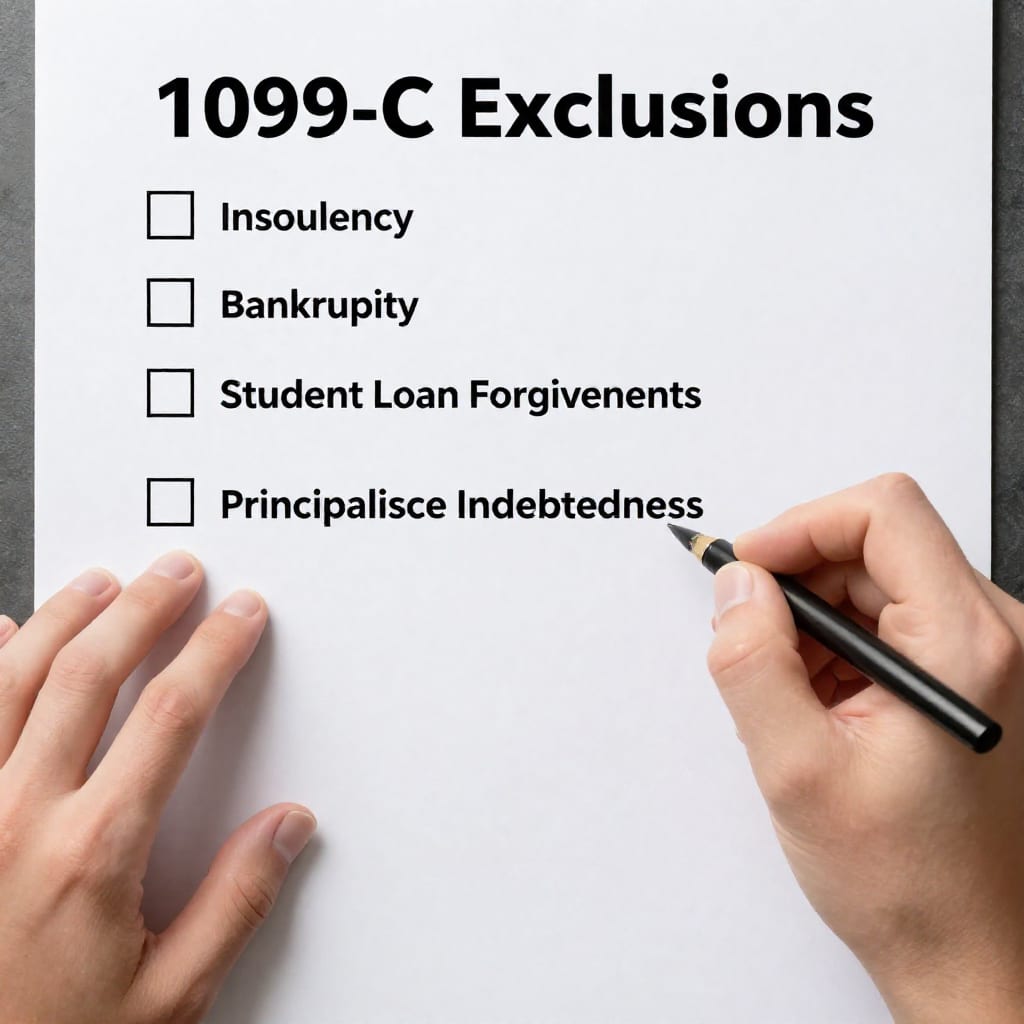
Exclusions and Exceptions: When You Don’t Have to Pay Tax on Canceled Debt
Here’s where things get hopeful. The IRS doesn’t expect you to pay tax on debt forgiveness if you were financially underwater at the time. The most common exclusions are:
1. Insolvency (the big one)
If your total liabilities (what you owe) exceeded your total assets (what you own) immediately before the debt was canceled, you can exclude the canceled debt from income—up to the amount you were insolvent. For example: if you had $30,000 in assets and $50,000 in debts, you were insolvent by $20,000. If a lender forgives $15,000 of that debt, the entire $15,000 is excludable. But if they forgive $25,000, only $20,000 is excludable, and you’d owe tax on the remaining $5,000.
You claim this exclusion by filing Form 982 (Reduction of Tax Attributes Due to Discharge of Indebtedness). It’s not hard, but you need to calculate your insolvency accurately. I once helped a client who had a $40,000 car loan on a car worth $25,000—that $15,000 negative equity counted toward insolvency, plus credit card balances and medical debt.
2. Bankruptcy
Debt discharged through Chapter 7 or Chapter 13 bankruptcy is not taxable. The 1099-C should reflect a code indicating bankruptcy in Box 6. If you file bankruptcy, you don’t report the canceled debt as income, and you don’t need Form 982 (though keeping records is wise).
3. Student loan forgiveness under specific programs
As of 2026, certain student loan forgiveness is still tax-free—specifically, forgiveness under Public Service Loan Forgiveness (PSLF), income-driven repayment (IDR) forgiveness after 20 or 25 years, and forgiveness due to death or disability. But be careful: private student loan forgiveness that isn’t part of a qualifying program is taxable. The IRS updates this regularly, so check current guidance.
4. Qualified principal residence indebtedness
If a lender forgives part of your mortgage debt through a short sale or foreclosure, you may be able to exclude up to $2 million ($1 million if married filing separately) of canceled debt related to your primary home. This exclusion is not permanent—it has been extended multiple times. For 2026, confirm whether it’s still in effect. If it is, you’ll claim it on Form 982.
5. Other niche exclusions
There are a few others—like debt canceled as a gift (rare), certain farm debts, and qualified real property business indebtedness—but the four above cover 95% of cases for individuals.
My personal take: If you think you might qualify for an exclusion, always file Form 982 rather than just ignoring the 1099-C. I’ve seen people skip it because they assumed insolvency automatically applied. It doesn’t. The IRS needs the form to know you’re claiming the exclusion. Without it, they’ll assume the debt is taxable and send a bill.
How to Report a 1099-C on Your Tax Return (Step by Step)
Reporting a 1099-C correctly is a two-path process: one if you owe tax on the canceled debt, and another if you’re claiming an exclusion. Here’s the step-by-step, based on what I’ve done for clients and for myself.
Path A: You Owe Tax (No Exclusion Applies)
- Enter the 1099-C data: On your Form 1040, report the canceled debt amount from Box 2 of the 1099-C on Line 8 (Other Income). Write “CODI” or “Canceled Debt” in the margin or as a description.
- Check for accuracy: Compare the amount on the form to your records. If it’s wrong, contact the lender for a corrected 1099-C before filing.
- Include with your return: You don’t need to attach the 1099-C itself, but keep it with your tax records in case of an audit.
- Pay the tax: If you owe, make a payment with your return or set up an installment plan. The IRS will add this income to your AGI, potentially pushing you into a higher bracket.
Path B: You Qualify for an Exclusion (Insolvency, Bankruptcy, etc.)
- Download Form 982 from the IRS website. You’ll need it to claim the exclusion.
- Complete Part I (Exclusion): Check the box for the applicable exclusion (e.g., Box 1b for insolvency). In Part II, list the amount of canceled debt you’re excluding.
- Calculate insolvency (if applicable): Use the IRS worksheet in the Form 982 instructions. List your total assets (cash, investments, car, home, retirement accounts) and total liabilities (mortgage, car loan, credit cards, medical bills, student loans). The difference is your insolvency amount.
- Attach Form 982 to your return. Do not report the canceled debt as income on Line 8. Instead, you’re essentially telling the IRS, “I don’t owe tax on this because I was insolvent.”
- Reduce tax attributes (if required): When you exclude canceled debt, you may need to reduce certain tax benefits—like net operating losses or capital loss carryforwards. This is often overlooked but important for future returns. The Form 982 instructions explain which attributes to reduce.
A quick example from my own experience: I helped a relative who had $12,000 in credit card debt forgiven after a job loss. She had $5,000 in savings, a car worth $8,000, and $22,000 in total debts. Her assets ($13,000) were less than her liabilities ($22,000), so she was insolvent by $9,000. Since the forgiven debt was $12,000, she could exclude only $9,000 and owed tax on the remaining $3,000. We filed Form 982 claiming the $9,000 exclusion, and reported $3,000 on Line 8. It wasn’t fun, but it was honest and avoided penalties.
Common mistake: People sometimes try to exclude the entire canceled debt even when they weren’t fully insolvent. The IRS will catch this during processing and may disallow the exclusion, leading to a bill plus interest. Be accurate, not optimistic.
Frequently Asked Questions
Do I have to pay taxes on a 1099-C I received this year?
Yes, unless you qualify for an exclusion like insolvency or bankruptcy. You must report it as income on your tax return. If you don’t, the IRS will likely match the form and send a notice.
What if the debt canceled on my 1099-C was not actually forgiven?
Contact the lender to verify the amount and request a corrected 1099-C. If the debt is still owed, dispute it with the IRS by sending a letter explaining the error, along with supporting documents.
Can I exclude canceled debt if I was insolvent at the time?
Yes, but you must file Form 982 to claim the insolvency exclusion. Insolvency means your liabilities exceeded your assets immediately before the cancellation. You’ll need to calculate the exact amount and attach the form to your return.
What happens if I ignore a 1099-C and don’t file it?
The IRS will likely match the form to your return and send a notice for unpaid taxes, plus penalties and interest. Ignoring it only makes the problem worse—eventually they can levy your bank account or wages.
Is student loan forgiveness taxable in 2026?
Only if it’s not a qualifying forgiveness program (e.g., Public Service Loan Forgiveness or income-driven repayment forgiveness after 20-25 years). Check IRS guidance for 2026, as rules can change. Private student loan forgiveness is generally taxable.
Your Practical Takeaway
Getting a 1099-C doesn’t have to be a disaster. The key is to act early: verify the amount, determine if an exclusion applies (insolvency is your best bet in most cases), and file the right forms. If you’re overwhelmed, a tax professional can help, especially with the insolvency calculation. But even doing it yourself is manageable—just don’t bury the form in a drawer and hope it goes away. It won’t.
One last piece of advice: keep a copy of the 1099-C and any correspondence with the lender for at least three years after filing. If the IRS ever questions your return, you’ll have the proof you need. And if you’re facing a debt settlement soon, talk to a tax advisor before you sign—it’s easier to plan for the tax hit than to scramble after the 1099-C arrives.
This guide should give you confidence to handle your 1099-C like a pro. Bookmark it for reference, and when tax season rolls around, you’ll know exactly what to do.